


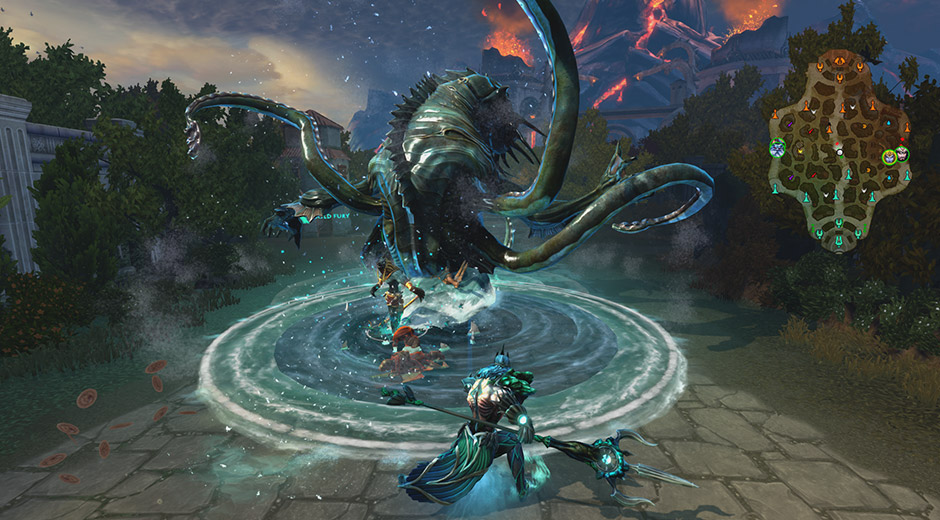
I play a lot of multiplayer online battle arena games (or “MOBAs”) on PC. I may not be the best player in the world, but I’m certainly not the worst – and one thing I can say for rootin’, tootin’ sure: Smite on Xbox One is, without question, the absolute best MOBA experience on console, ever. Period. It’s a fantastic game whether you’re playing on Windows or Xbox One, but if you’re a dyed-in-the-wool console guy, and you’re dying (in the wool or otherwise) to get into MOBAs, you had better get your hands on Smite right now.
OK, so you’re intimidated. You’ve seen Let’s Play videos of guys joining MOBA matches online and getting yelled at, and you don’t want to be “that guy.” Well, have no fear. First of all, Smite doesn’t allocate loot (experience points and gold) the way most MOBAs do – dealing the final hit on a mob (basic, A.I. enemy) only nets you a small extra amount of gold and XP. Everyone else who’s nearby gets nearly the same amount as you do. So if you take someone’s kill, he’s not gonna flip out. Second: Smite is pretty much the only bona fide MOBA on Xbox One right now. What do you think, everybody out there is an expert overnight? So just grab your controller and get in the game!
To take you a step further from noob-ville, I’ve made up this handy-dandy guide that will lay out some of the basic roles, responsibilities, and terms of Smite for you. Read it, but also be sure to tackle Smite’s tutorials, and play a few basic Joust matches. You’ll find the game easy to learn and difficult to master.
The Basics
Smite, like all MOBAs, is about two opposing teams trying to dominate the other. Unlike most MOBAs, though, Smite has several game modes. The core mode is Conquest, and this is where you’ll spend most of your time. In Conquest, two teams of five gods face off on a map with three main pathways (or “lanes”), and try to reach and destroy the other team’s Titan. Arena mode is a straight five-on-five deathmatch, with no Titans to protect; just kill the opposing players until they run out of lives. Assault mode is what most other MOBAs refer to as ARAM (“all random, all mid”) – just one middle lane to fight in, and everyone gets a random god to play as (though you can pay a little gold to roll the dice a second time). Joust is the one-on-one mode (although you can play three-on-three, too), and it’s mostly used for practicing and learning with a friend, or against a noob like yourself. When you begin, I urge you to play Joust several times, to get a feel for the different kinds of gods.
The Roles
When you’re not playing Joust, you’ll spend most of your time in Conquest, where each of the five team members can hold one or more key roles. You’ll hear a lot of lingo bandied about, but you need to know a few things to understand the basics of what you’re supposed to do. Essentially, the roles can be broken down into five basic tasks, but keep in mind that advanced players (and gods) will often combine and hybridize these, and a given team’s strategy may call for more flexibility than this list suggests:
- The Solo: Solos are about pushing and pulling, and are probably the simplest role to understand for new players – although not the simplest to execute on, necessarily. A solo’s job is to push down a given lane and hold back the enemy players and minions. Most important for a solo is to absolutely not die. Getting overwhelmed and crushed, even if your god has a fast respawn time, can lead to disaster if the enemy team can wreck your defensive tower while you’re gone… so your best bet is to be conservative, pick your spots, and pull back when necessary.
An important thing to know about this role is that it shifts later in the game – one of the neat things about Smite, as opposed to some other MOBAs, is that you have to be good at more than one thing. Once you’ve taken down the enemy tower in your lane, you’ll need to be able to move on and help other players around the map, either in other lanes or just with random hotspots. This means you can’t pick a god who is only good at taking down towers. Your team will win that one segment of your lane, but likely lose the whole fight. Make sure you get good at the transition from conservative solo to utility god.
Recommended gods: Guan-Yu, Tyr, Hades, Vamana
- The Mid: Because the middle lane is, well, in the middle of things, people who choose to solo the mid have a slightly different task than other solo laners. They have to push and control their lanes, yes… but they also need to keep an eye on what’s going down on the minimap for opportunities to take extra bounties where possible. Farming minions, “ganking” opponents (taking down an unsuspecting, retreating player), and helping out in the jungle area, are all things a clever mid player can do to increase his or her experience gain quickly.
Ultimately, mid is about clearing the enemy tower and leveling up quickly – and because mid is in the thick of things, characters with powerful AoE (area of effect) attacks are usually preferred. This generally means mages – but not always. There are effective gods of all types who can play mid, it’s just a question of preference.
Recommended gods: Ra, Agni, Scylla, Janus
- The Support: “Support” is the catch-all term for the utility man on a Smite team. Generally, the support is a more experienced player, but on a team of all noobs, this role should be taken by someone who likes to experience a little bit of everything. The support player is a caretaker. His job is to look after the other players in a variety of ways, crowd control (“CC,” taking down enemy minions) so his team can concentrate on other players, heal his teammates, tank damage (purposely absorbing damage from the opposing team so his teammates can survive longer), and even help out in the Jungle.
This is a diverse role, so it’s hard to describe in a short paragraph – but if you choose support, be ready to improvise and think quickly. Because the role is so diverse, a whole bunch of different gods will fit in it, so the good news is that you don’t have to be too choosy, and it’s a good role to choose if you’re forced to go random.
Recommended gods: Ymir, Sylvanus, Athena
- The Jungler: No, not the “juggler.” The jungler is the free-roaming, free-spirited guy who goes around and kills creeps (A.I. monsters), clears out camps so his team can benefit from the buffs, then guards those camps to make sure they stay on his team’s side. The minimap is the absolute corner-of-the-eye key element of any successful jungler. You have to play with fish eyes: one eye on the game, one eye on the minimap, to make sure that nobody is messing with your stuff – and if they are, that you are all over them instantly. You also want to take advantage of any weakened enemy junglers who have bitten off more than they can chew; jump on them and take them out for a nice experience (and morale) boost.
Jungling is a fun role, but it can become high-pressure quickly, since your team tends to pull you all over the place with demands for help… and then anger when you stick around too long in fights that you don’t need to be involved in. If you’re a loner with a thick skin, then this role is for you.
Recommended gods: Thor, Serqet Nemesis, Kali
- The Carry: Often called the “ADC,” an acronym of this role’s more comprehensive name: Attack-damage-carry, the “carry,” is so named because of this role’s goal, to “carry” the team to victory late in the match. The purpose of the carry is to do a lot of damage and get a lot of kills – not out of a desire for violence qua violence, but because the carry needs to get leveled up fast. Indeed, much of the mid game will involve the carry’s teammates “feeding” them kills in order to gain levels quickly, and put the team in as strong a late game position as possible – that’s how critical this role is late in the game.
The carry is a fairly straightforward role (“kill stuff”), but it requires restraint, teamwork, and a set of cool nerves. You absolutely cannot get killed early, or get out of control late-game. Auto-attacking will be helpful, but you still need to manage exactly what you’re doing and make sure you’re doing it in concert with your teammates. Crushing your foes always feels good, but getting separated from your teammates for too long will lead to a ganking for sure.
Recommended gods: Neith, Ah Muzen Cab, Apollo
What Not to Do
So, now you have a basic sense of what to do, and who to play to do it. But before I close, I want to leave you with a few key “don’ts.”
- Don’t clam up – You may be intimidated by more experienced players. Don’t be quiet. Smite is all about communication. Use the mic that came with your controller!
- Don’t try to be a hero – This is not Team Fortress 2. You don’t get points for your team by killing the enemy alone and being an awesome hero, then dying. Work a strategy; be conservative.
- Don’t ad hoc build – This is outside the scope of this guide, but as you play the game, you’ll learn what builds (equipment) work best for what gods you like to use, and in what scenarios. Have those ready to go before you start each match. Don’t make people wait around while you select piece-by-piece.
- Don’t stand around! – A.B.F.: Always be farming. Seriously. If you have nothing to do, go kill some minions, grab a camp, go to the jungle, support a player. Always be farming (building your stats/buffs). It doesn’t matter how good your micromanagement skills are; if the enemy team is higher level than you, they will win. Always be doing something productive.
- Don’t switch lanes unless you have a plan – Seriously. Unless your team has a coordinated plan to do this, NEVER switch lanes that you’re assigned to. You will get serious aggro thrown your way. Be a good neighbor.
- Don’t get discouraged – You’re new! This is a game! Have fun. There will be jerks, but most folks are new like you, and most folks are nice. Ask for advice, watch, and learn. You’ll get there.