Summary
- How every expedition can lead to a different build.
- Change the way you fight through module synergies and directional attacks.
- Every build creates a unique path to uncover Polo’s story.
When I enter a new expedition in Cat-Astrophy, I don’t start with a fixed build that I have to repeat. I start with a question: what kind of Polo am I going to build this time? That idea is at the core of the module system, and it’s why two runs can take me down completely different paths, even when I return to a planet I already know.
During each run, I find modules that can modify specific abilities, stats, or systems. Some improve close-range combat, while others favour mobility, defence, or a more strategic approach. The key is that I don’t have to decide everything before I start: the build takes shape through what I find, what I keep, and how I react to each situation.
The most interesting part comes when modules stop working as isolated pieces. Some can evolve, while others hide synergies that only become apparent when combined. An upgrade that seems simple on its own can end up changing the way I move, attack, or navigate a room. At that point, the expedition becomes more than a succession of fights. It becomes an experiment: I try a combination, see what it does, and decide whether it’s worth building around.
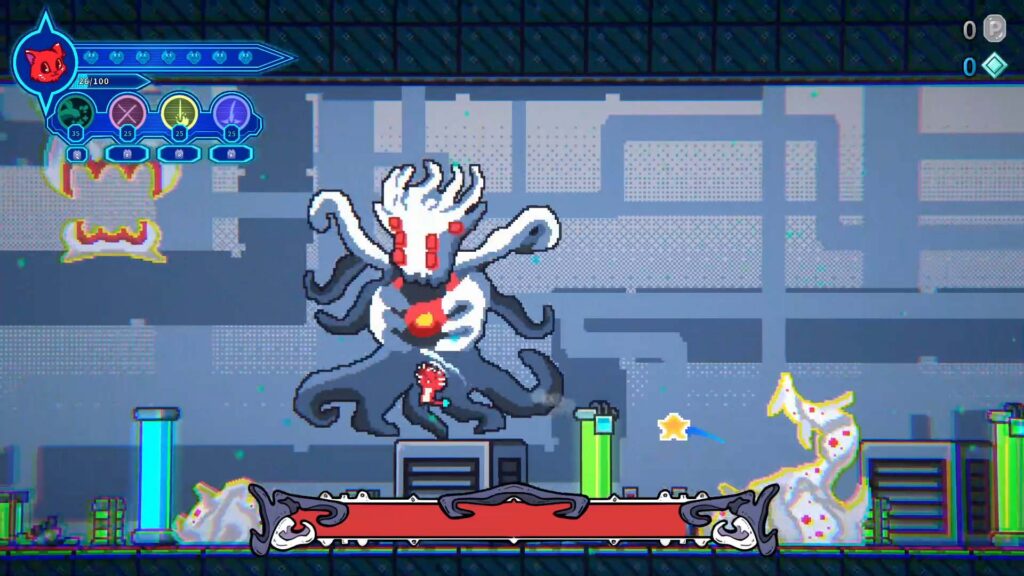
The same principle extends to combat. Cat-Astrophy uses directional attacks that can be customized for forward, upward, and downward strikes. Each direction has different variants and can create synergies with my modules. On top of that, fatigue builds up as you chain attacks together, so maintaining a combo isn’t simply about using the same attack over and over. You have to decide when to keep pushing and when to stop and regain control of the situation. The result is a system that rewards precision and adaptation rather than relying on a single optimal combination.
Route selection is also part of the build. Each planet has different mechanics, enemies, and rewards, and you can choose their order from the ship that serves as your central hub. One route might favour an offensive build, while another could work better with a setup focused on survival or mobility. At the same time, rooms don’t follow a single path: you can encounter combat, parkour sections, events, shops, and minibosses, and decide how far you want to deviate from your route to look for a reward.
And even when an expedition ends with Polo’s death, not everything resets. The Star Fragments you collect can be used to unlock permanent upgrades, new options, and new routes for future runs. You can also discover memory fragments that gradually reveal Polo’s past and the truth behind his abduction. This gives every attempt two layers of progression: the build you’re creating now and the possibilities you’re unlocking for later.
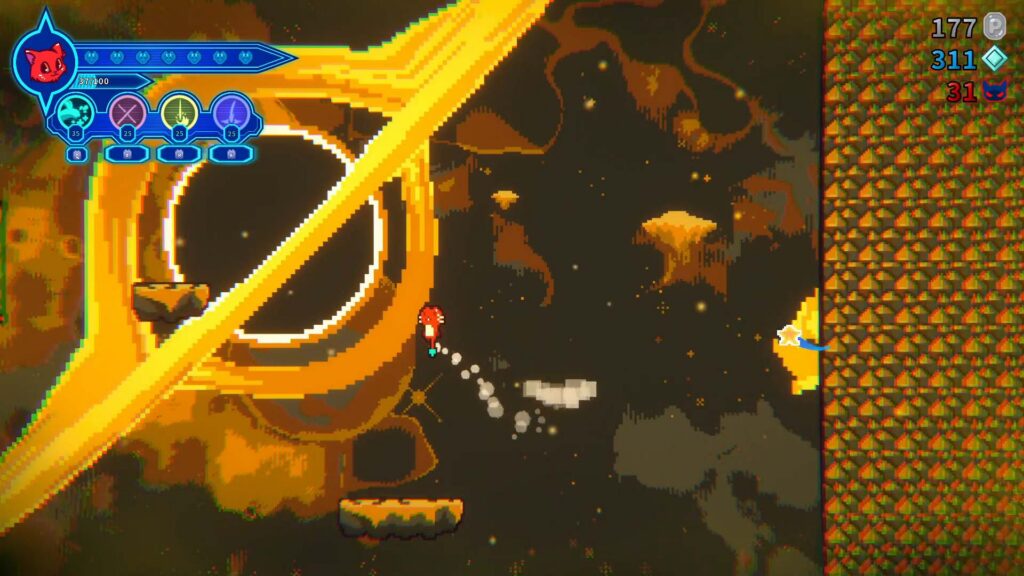
That’s why there is no single “correct” build in Cat-Astrophy. You can prioritise fast attacks and combos, look for a more durable setup, or focus on mobility. Even the same planet can feel different when you arrive with a different combination of modules, a different route, and a different approach to combat. The reward isn’t just finding a powerful upgrade, but understanding why it works and what other decisions it can unlock.
For me, that experimentation is the true heart of the experience. Every run starts with a handful of tools and ends up telling a small story through its decisions: the unexpected combination that worked, the risk that paid off, the module that completely changed a strategy, or the route that opened up a new opportunity. In a roguelite, repetition can be part of the challenge; in Cat-Astrophy, every repetition also gives you a reason to try something different.
Cat-Astrophy is out now on XBOX, alongside Steam, Nintendo Switch, and PlayStation. The combination of builds, routes, and permanent progression is designed so that every expedition can start in a similar way and end up completely differently.
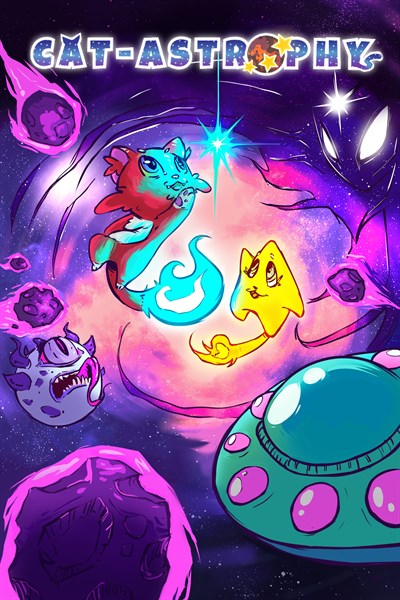
Cat-Astrophy
Pdpartid@games